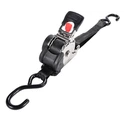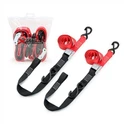

In the world of cargo securement, efficiency and safety are paramount. While traditional ratchet straps have been the industry standard for decades, Retractable Ratchet Straps have revolutionized the way professionals and DIYers alike secure their loads.
At XiangleTools, we believe that understanding the science behind your equipment is the first step toward safer transport. In this comprehensive guide, we explore the mechanical engineering of automatic tie-downs, provide a step-by-step operational manual, and offer expert maintenance tips to extend the life of your gear.
Part 1: Mechanical Engineering & Materials Science
The core advantage of a retractable ratchet strap lies in its integrated mechanical logic, similar to a vehicle's seatbelt or a heavy-duty tape measure.
1.1 Core Components & Technical Specifications
A retractable strap is a high-precision system. We utilize reinforced composite plastics or galvanized steel housings to protect the internal power spring from debris and physical impact.
|
Component |
Material & Process |
Function & Performance Metric |
|---|---|---|
|
High-Tenacity Webbing |
100% Industrial Polyester |
Low stretch (<7%), UV resistant, high load support. |
|
Auto-Retract Spool |
Tempered Carbon Spring Steel |
Provides constant tension for automatic rewinding. |
|
Ratchet Mechanism |
Cold-Forged Alloy Steel |
High-ratio mechanical advantage for final tensioning. |
|
Locking Pawl |
Heat-Treated Hardened Steel |
Unidirectional engagement to prevent loosening during vibration. |
|
End Fittings |
Vinyl-Coated S/J Hooks |
Secure anchoring with protective coating to prevent scratching. |
1.2 The Science of Polyester vs. Nylon
Why does XiangleTools use Polyester? In industrial practice, polyester is superior to nylon for tie-downs because:
- Moisture Stability: Polyester does not stretch or lose strength when wet.
- Minimal Elongation: It typically stretches only 3-7% at break strength, ensuring cargo remains immobile during long-haul transport.
- Environmental Resistance: It is naturally resistant to UV degradation and mildew.
Part 2: The Cornerstone User Manual
Efficiency meets safety in our standard operating procedure. Follow these steps to ensure a perfect securement every time.
2.1 The "60-Second Pre-Check"
Before use, perform a quick inspection:
- The Wake-up Test: Press the release button. The webbing should pull out smoothly under light tension.
- Webbing Integrity: Check for cuts, abrasions, or heat-fused spots. Note: Even 10% edge wear can reduce total breaking strength by over 30%.
2.2 Standard 5-Step Operation
- Pull & Position: Depress the release lever (usually the red or white button) to enter free-spool mode. Pull out the required length. Avoid over-extending to protect the internal spring's elastic limit.
- Hook to Anchor: Secure the hooks to reinforced anchor points (D-rings or E-tracks). Ensure the webbing is flat; twisted webbing creates uneven stress distribution and significantly weakens the system.
- Auto-Retract Slack: Release the button. The internal mechanism will automatically take up the slack. This prevents "soft-spooling," where loose layers on the drum lead to tension loss during transit.
- Mechanical Tensioning: Cycle the ratchet handle up and down. Tighten until the cargo shows slight compression or the strap is as "tight as a guitar string." Do not over-tighten on fragile goods or light-duty vehicle rails.
- Lock the Handle: Push the handle completely flat. You should hear a distinct "click" as the pawl locks. This prevents accidental release and eliminates "strap flap" at highway speeds.
2.3 Understanding the Math: BS vs. WLL
Following WSTDA T-1 and DOT standards, we use a 3:1 safety factor for all tie-down calculations:
\( \text{WLL (Working Load Limit)} = \frac{\text{BS (Breaking Strength)}}{3} \)
|
Strap Width |
Typical WLL Range |
Recommended Application |
|---|---|---|
|
1-Inch |
500 - 1,100 lbs |
Bicycles, kayaks, pickup truck beds. |
|
1.5 - 2 Inch |
1,500 - 3,335 lbs |
ATVs, motorcycles, furniture transport. |
|
2 - 3 Inch |
3,335 - 5,670 lbs |
Industrial equipment, flatbed trailers. |
Part 3: Industry Insights: Optimization by Sector
3.1 Marine Transport: The Anti-Corrosion Strategy
In saltwater environments, corrosion is your #1 enemy. We recommend Stainless Steel retractable units for marine use. For Transom Tie-Downs, use "Bolt-on" designs to save time at busy boat ramps.
- Expert Tip: Maintain an angle of no more than 30 degrees from vertical to avoid lateral friction against the hull.
3.2 Powersports: Managing Suspension Compression
When securing motorcycles or ATVs, you must reach the "Suspension Sweet Spot."
- Under-compressed: A bump in the road causes the suspension to dip, making the strap go slack and the hook fall off.
- Over-compressed: You risk blowing your fork seals.
- The Rule: Compress the suspension 25% to 50% of its travel. Use Soft Loops to protect chrome handlebars and paintwork.
3.3 Winter Operations: Extreme Cold Performance
In sub-zero temperatures, grease can thicken, and moisture in the webbing can freeze.
- Solution: Do not force a frozen mechanism. Use a PTFE-based dry lubricant (teflon) to maintain smooth retraction in winter.
Part 4: Maintenance & Lifespan Management
While retractable mechanisms offer superior convenience, they require specific care. A well-maintained XiangleTools strap lasts 2-3 years; a neglected one may fail in months.
4.1 The "Dry Lube" Rule
Never use heavy oil or grease. These attract road grit and sand, creating an abrasive paste that grinds down the ratchet teeth. Always use a Dry PTFE Spray.
4.2 Troubleshooting Matrix
|
Symptom |
Potential Cause |
Fix |
|---|---|---|
|
Won't Retract |
Internal spring snag / Twisted webbing. |
Pull webbing out fully, straighten, and clear debris. |
|
Won't Lock |
Icing or worn pawl spring. |
Clear ice; if teeth are rounded/worn, replace the unit. |
|
Heavy Handle |
Over-tensioned / Spool jam. |
Use a flathead screwdriver to assist the pawl while cycling. |
4.3 Retirement Criteria: When to Replace?
According to WSTDA safety principles, discard the strap immediately if:
- Visible burn marks or chemical charring.
- The ratchet handle is bent or deformed.
- Stitching at the spool is frayed for more than 1 inch.
- Significant color fading (indicates UV fiber embrittlement).
Looking for professional-grade cargo solutions? Visit us at XiangleTools to browse our latest collection of automatic retractable tie-downs.
Written by Dustin Xu, XiangleTools Engineering & Safety Division.